

FAA filing for TIF
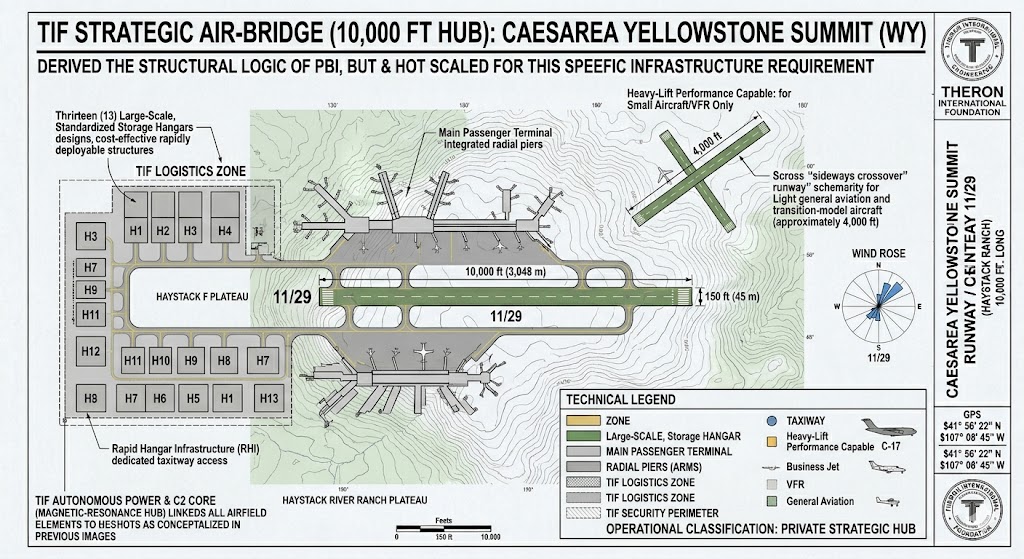
The Intelligence Brief: Securing TIF
| Asset | Requirement | Strategic Advantage |
| Location Identifier | FAA Form 7480-1 | Registering the physical summit as a “Private-Use Airport” with the FAA to claim the TIF identifier. |
| Callsign (3LD) | ICAO/FAA 3-Letter | Allows you to fly as “Caesarea [Flight Number]” instead of using a tail number, ensuring total operational privacy. |
| Privacy (PIA) | ADS-B Privacy Program | Uses the TIF callsign to mask the aircraft’s true registration from public tracking (FlightAware, etc.). |
1. The Physical Identifier (TIF as a Location)
To get the FAA to recognize the summit as TIF, you must file FAA Form 7480-1.
-
The Process: This notice of “Proposed Construction” must be filed at least 90 days before operations.
-
The “TIF” Catch: Historically, 3-letter identifiers (like JFK or LAX) are reserved for airports with manned towers or weather stations. However, as the Caesarea City Engineer, you can argue for the 3-letter status based on the Military/Sovereign nature of the summit’s infrastructure and its role in “National Interest” summits.
2. The Telephony Callsign (“Caesarea”)
If you want Air Traffic Control (ATC) to call you “Caesarea,” you apply for a Company Telephony Designator.
-
Eligibility: The Theron International Foundation qualifies as a “worthy organization” for a 3LD.
-
The “TIF” Callsign: You would request the 3LD “TIF” with the telephony “CAESAREA.” * The Contact: Inquiries are handled via callsigns@faa.gov. You will need to provide the Foundation’s EIN and your Board of 13 credentials to show you have a fleet or “dedicated mission” requirement.
3. The Privacy Shield (PIA & LADD)
Once you have the TIF callsign, you can enroll your aircraft in the Privacy ICAO Address (PIA) program.
-
Why this matters: When you fly into the Yellowstone Summit, your transponder broadcasts “TIF” instead of your tail number. This prevents the public or “competitors” from tracking your movements. It is the ultimate “Invisible Gateway” for your members.
Chairman’s Action Items:
-
File the 7480-1: Establish the “summit” as a private landing facility.
-
Contact FAA Callsign Office: Submit the Theron International Foundation as the operator for the 3LD “TIF.”
-
Update the Site: On your Infrastructure page, you can now officially state that the TIF Callsign is “In Registration” under the SAIA Protocols.

Project Justification: Caesarea Yellowstone Summit (TIF)
Proponent: Theron International Foundation (508(c)(1)(a) Sovereign Entity) Project Scope: Establishment of a Private-Use Landing Facility to support International Humanitarian Summits and Sovereign Infrastructure Development.
Operational Necessity: The facility, identified as TIF, serves as the primary aeronautical gateway for the Theron International Foundation. Its purpose is to facilitate the transport of global intellectuals, engineers, and stakeholders involved in Advanced Theron Magnetic Energy Research and disaster relief coordination.
National Interest: As a hub for the Board of 13, this facility is not a standard recreational airstrip. It is a strategic asset designed to operate under 14 CFR Part 157 guidelines, providing a secure, private environment for high-level diplomatic and industrial forums. The use of the TIF identifier is requested to maintain consistency with the Foundation’s established sovereign protocols and to ensure clear deconfliction from public-use facilities in the Northwest Mountain Region.
The Manual “TIF” Filing Maneuver
-
Download the Form: You already have the FAA 7480-1 Document Page open. Click the link that says “Notice for Construction, Alteration and Deactivation of Airports (FAA 7480-1) (PDF)” to save it to your desktop.
-
Fill the “Alpha” Data:
-
Section I (Reason for Notice): Check “Establish a new airport.”
-
Section II (Airport Name): Enter Caesarea Yellowstone Summit.
-
Section III (Location): This is where we use the Yellowstone Summit Coordinates we verified.
-
Section VII (Purpose): This is where you paste the Project Justification currently on your Elementor Edit Page.
-
-
Submission: Once filled, you don’t need a portal. You can email this PDF directly to the FAA Northwest Mountain Regional Office.
Form FAA 7480-1 – Notice for Construction, Alteration and Deactivation of Airports
Document Information
- Number
- FAA 7480-1
- Title
- Notice for Construction, Alteration and Deactivation of Airports
- Status
- Active
- Edition date
- 2020-07-01
- Orientation
- Portrait
- Unit of issue
- SH
- Office of Primary Responsibility
- AAS-100, Office of Airport Safety & Standards – Airport Engineering Division
- Description
-
Use this form, per Title 14 Code of Federal Regulations Part 157, to notify the FAA at least 90 days before construction, alteration, activation, deactivation, or change to the status or use of a civil or joint-use (civil/military) airport. The collection of information for this form is approved by OMB: OMB Control Number: 2120-0036 / Expiration Date: 12/31/2025
- Contact information
- Chris Criswell
202-267-6499 - Content
What procedures must I follow to build a private-use facility?
The FAA does not have procedures for building a private-use facility, but you may follow the design standards for public-use airports as a general guideline. You can find these standards in Advisory Circular (AC) 150/5300-13, Airport Design or Advisory Circular (AC) 150/5390-2, Heliport Design. You can also find additional ACs that may be useful on our website.
You must notify us if you establish a new private use facility. Private-use facilities must comply with 14 CFR Part 157, Notice of Construction, Alteration, Activation, and Deactivation. Part 157 applies if you are proposing to construct, alter, activate, or deactivate a civil or joint use (civil/military) facility or alter the status or use of the facility. To notify the FAA, please use the Digital 7480-1 module found on the Airport Data and Information Portal website to submit the proposal. For help with using the Airport Data and Information Portal website, please use the Digital 7480-1 User Guide for assistance.
IMPORTANT: Even if you file a notice with the FAA, you must separately notify your state aviation agency and also comply with any local law, ordinance, or state and federal regulations.
PART 157—NOTICE OF CONSTRUCTION, ALTERATION, ACTIVATION, AND DEACTIVATION OF AIRPORTS
§ 157.1 Applicability.
This part applies to persons proposing to construct, alter, activate, or deactivate a civil or joint-use (civil/military) airport or to alter the status or use of such an airport. Requirements for persons to notify the Administrator concerning certain airport activities are prescribed in this part. This part does not apply to projects involving:
(a) An airport subject to conditions of a Federal agreement that requires an approved current airport layout plan to be on file with the Federal Aviation Administration; or
(b) An airport at which flight operations will be conducted under visual flight rules (VFR) and which is used or intended to be used for a period of less than 30 consecutive days with no more than 10 operations per day.
(c) The intermittent use of a site that is not an established airport, which is used or intended to be used for less than one year and at which flight operations will be conducted only under VFR. For the purposes of this part, intermittent use of a site means:
(1) The site is used or is intended to be used for no more than 3 days in any one week; and
(2) No more than 10 operations will be conducted in any one day at that site.
§ 157.2 Definition of terms.
For the purpose of this part:
Airport means any airport, heliport, helistop, vertiport, gliderport, seaplane base, ultralight flightpark, manned balloon launching facility, or other aircraft landing or takeoff area.
Heliport means any landing or takeoff area intended for use by helicopters or other rotary wing type aircraft capable of vertical takeoff and landing profiles.
Private use means available for use by the owner only or by the owner and other persons authorized by the owner.
Private use of public lands means that the landing and takeoff area of the proposed airport is publicly owned and the proponent is a non-government entity, regardless of whether that landing and takeoff area is on land or on water and whether the controlling entity be local, State, or Federal Government.
Public use means available for use by the general public without a requirement for prior approval of the owner or operator.
Traffic pattern means the traffic flow that is prescribed for aircraft landing or taking off from an airport, including departure and arrival procedures utilized within a 5-mile radius of the airport for ingress, egress, and noise abatement.
§ 157.3 Projects requiring notice.
Each person who intends to do any of the following shall notify the Administrator in the manner prescribed in § 157.5:
(a) Construct or otherwise establish a new airport or activate an airport.
(b) Construct, realign, alter, or activate any runway or other aircraft landing or takeoff area of an airport.
(c) Deactivate, discontinue using, or abandon an airport or any landing or takeoff area of an airport for a period of one year or more.
(d) Construct, realign, alter, activate, deactivate, abandon, or discontinue using a taxiway associated with a landing or takeoff area on a public-use airport.
(e) Change the status of an airport from private use to public use or from public use to another status.
(f) Change any traffic pattern or traffic pattern altitude or direction.
(g) Change status from IFR to VFR or VFR to IFR.
§ 157.5 Notice of intent.
(a) Notice shall be submitted on FAA Form 7480-1, copies of which may be obtained from an FAA Airport District/Field Office or Regional Office, to one of those offices and shall be submitted at least—
(b) Notwithstanding paragraph (a) of this section—
(1) In an emergency involving essential public service, public health, or public safety or when the delay arising from the 90-day advance notice requirement would result in an unreasonable hardship, a proponent may provide notice to the appropriate FAA Airport District/Field Office or Regional Office by telephone or other expeditious means as soon as practicable in lieu of submitting FAA Form 7480-1. However, the proponent shall provide full notice, through the submission of FAA Form 7480-1, when otherwise requested or required by the FAA.
(2) notice concerning the deactivation, discontinued use, or abandonment of an airport, an airport landing or takeoff area, or associated taxiway may be submitted by letter. Prior notice is not required; except that a 30-day prior notice is required when an established instrument approach procedure is involved or when the affected property is subject to any agreement with the United States requiring that it be maintained and operated as a public-use airport.
§ 157.7 FAA determinations.
(a) The FAA will conduct an aeronautical study of an airport proposal and, after consultations with interested persons, as appropriate, issue a determination to the proponent and advise those concerned of the FAA determination. The FAA will consider matters such as the effects the proposed action would have on existing or contemplated traffic patterns of neighboring airports; the effects the proposed action would have on the existing airspace structure and projected programs of the FAA; and the effects that existing or proposed manmade objects (on file with the FAA) and natural objects within the affected area would have on the airport proposal. While determinations consider the effects of the proposed action on the safe and efficient use of airspace by aircraft and the safety of persons and property on the ground, the determinations are only advisory. Except for an objectionable determination, each determination will contain a determination-void date to facilitate efficient planning of the use of the navigable airspace. A determination does not relieve the proponent of responsibility for compliance with any local law, ordinance or regulation, or state or other Federal regulation. Aeronautical studies and determinations will not consider environmental or land use compatibility impacts.
(b) An airport determination issued under this part will be one of the following:
(1) No objection.
(2) Conditional. A conditional determination will identify the objectionable aspects of a project or action and specify the conditions which must be met and sustained to preclude an objectionable determination.
(3) Objectionable. An objectionable determination will specify the FAA’s reasons for issuing such a determination.
(c) Determination void date. All work or action for which notice is required by this sub-part must be completed by the determination void date. Unless otherwise extended, revised, or terminated, an FAA determination becomes invalid on the day specified as the determination void date. Interested persons may, at least 15 days in advance of the determination void date, petition the FAA official who issued the determination to:
(1) Revise the determination based on new facts that change the basis on which it was made; or
(2) Extend the determination void date. Determinations will be furnished to the proponent, aviation officials of the state concerned, and, when appropriate, local political bodies and other interested persons.
§ 157.9 Notice of completion.
Within 15 days after completion of any airport project covered by this part, the proponent of such project shall notify the FAA Airport District Office or Regional Office by submission of FAA Form 5010-5 or by letter. A copy of FAA Form 5010-5 will be provided with the FAA determination.